Karoo
Heart of the HunterThe Karoo is both a physical obstacle and a strategic space in Thobela Mpayipheli’s flight north: its long distances make the journey difficult to sustain, while the N1’s prominence makes it the route his pursuers are most likely to watch. For Mpayipheli, crossing it means managing a powerful unfamiliar motorcycle, conserving time, and deciding when to leave the highway. A pause among its ridges also widens the story’s scale, connecting his immediate pursuit to a much older landscape of life, death, and human conflict.
Setting and Route
After the road beyond Touws River loses its bends, Mpayipheli can turn his attention from handling the motorcycle to the journey ahead. The petrol gauge indicates that he must refuel at Laingsburg. From there, he faces about 200 kilometres to Beaufort West, followed by another 500 or 550 kilometres to Bloemfontein. The distances make the Karoo leg more than a passage between named towns: it is a sequence of fuel decisions, estimates, and possible stopping points, with arrival in Bloemfontein before sunrise uncertain.
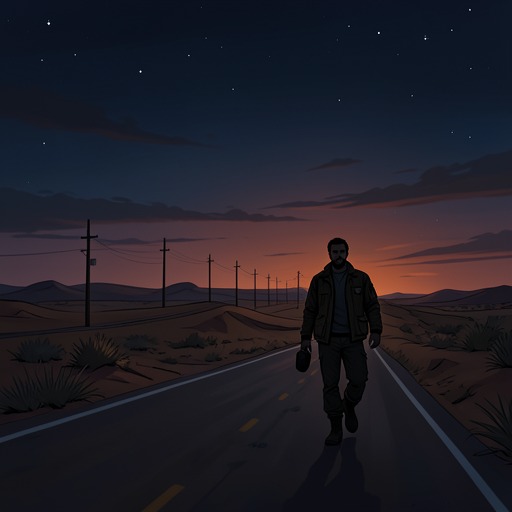
The account distinguishes the Great Karoo from a neutral stretch of road. Its highway is described as wide and straight, oppressive in daytime heat and soul-destroying at night. Those conditions shape the practical choices Mpayipheli must make. He expects to ride through the night, then sleep in Bloemfontein and rest during daylight in a Black township. The route is therefore measured not only in kilometres but in the hours his body can remain alert and the opportunities he will have to stop without being found.
The Highway as a Tactical Problem
Mpayipheli’s concern is not simply whether he can cover the distance. He does not know whether his pursuers have discovered that he took the motorcycle, or whether failing to switch off its alarm has already alerted them. If they do not yet know, he may have until eight or nine the following morning before a message goes out. If they do know, he expects them to reason from probability: the N1 is the fastest, shortest main route, and so the likeliest place to concentrate their resources, even though it is far from the only possible route.
That calculation makes the Karoo’s openness double-edged. The main road promises speed and a direct path north, but it also offers a predictable line for surveillance and interception. Mpayipheli knows that the hunters’ alternatives multiply as routes diverge; their uncertainty is useful to him only if he preserves his lead. He switches on his high beam and accelerates along the dark highway, weighing speed against the danger of riding fast at night. Elsewhere on the journey, the BMW R 1150 GS has already proved difficult to control: its power and size are unlike those of his small Honda Benly, and even starting from the traffic lights requires care. The road’s demands therefore include both tactical judgment and the immediate work of mastering a machine that can carry him quickly but is not yet familiar.
Leaving the N1
When Mpayipheli suspects that a roadblock lies ahead, remaining on the highway is no longer a safe default. He considers turning back or finding another route, but rejects retreat and continues north. Instead, he moves slowly beside the road, scanning the wire fence for a farm gate or a place where he can pass beneath it. He estimates that the roadblock may be only a few kilometres away and listens for signs that could expose him.
He finds an unlocked gate on the opposite side of the road, leading to a two-track route into the veld. He crosses the highway, rides over gravel, opens the gate, takes the motorcycle inside, and closes the gate behind him. The manoeuvre changes the road from a single exposed corridor into a boundary he can cross and leave behind. It also shows how escape depends on small features of the landscape: a gate without a padlock, a track away from the highway, and enough distance from the traffic to stop and think. Later, while concealed in the back of a Chevrolet El Camino among furniture and luggage, he looks back on a moment when he restrained an impulse and chose reason. The journey’s evasions are not only changes of route; they also test his control over his own responses.
Landscape and Meaning
During one pause, Mpayipheli sits with his back against a rock and watches the lights of the N1. The ridges and unfamiliar terrain prompt him to imagine an earlier world: rainforests, dinosaur bones, waterfalls, and the sounds of animals hunting and being hunted. The scene briefly shifts the scale of attention away from the pursuing vehicles and the immediate calculation of distance. The landscape becomes a record of immense change, in which life and death have long existed together.
From that reflection, the thought turns to human history. Mpayipheli considers how neither glaciation nor other changes to the land could stop bloodshed, and imagines humanity as a predator that, unlike the forces of nature, cannot be held in balance. His thought moves through conflict between white and white, black and black, and white and black, before he wonders whether Africa and this land have hope. The phrase “The Red Continent” gives this meditation its stark counterpoint to the familiar image of a dark continent: the Karoo is not merely an empty interval on an escape route, but a place where the story’s immediate pursuit opens onto a longer history of violence.
Narrative Significance
The Karoo’s role lies in the tension between what its roads make possible and what their predictability makes dangerous. The N1 offers a fast northbound passage, but the same straight, prominent route is the one Mpayipheli expects his pursuers to choose. Leaving it requires attention to less conspicuous features of the terrain and acceptance of delay and uncertainty. The landscape thus gives practical form to the contest between a fugitive’s changing path and the authorities’ attempt to anticipate it.
At the same time, the pause beside the highway prevents the setting from functioning only as an obstacle. Mpayipheli’s attention to the ridges, ancient life, and recurring bloodshed connects the personal danger of his flight to a larger question about violence and hope. The road measures a journey north; the surrounding land makes that journey carry a historical and moral weight.